
Hensoncrest Ltd. © 2026 • All Right Reserved, CryptoNumbered™ is a trademark of Hensoncrest • Patent Pending • Business liability insurance provided by Berkshire Hathaway
HOW CRYPTONUMBERED WORKS
The Artifact
A CryptoNumbered™ artifact can be almost anything of value or significance; artwork, jewelry, musical instruments, coins, collectibles, documents, antiques, memorabilia, and more.
You Present the Artifact
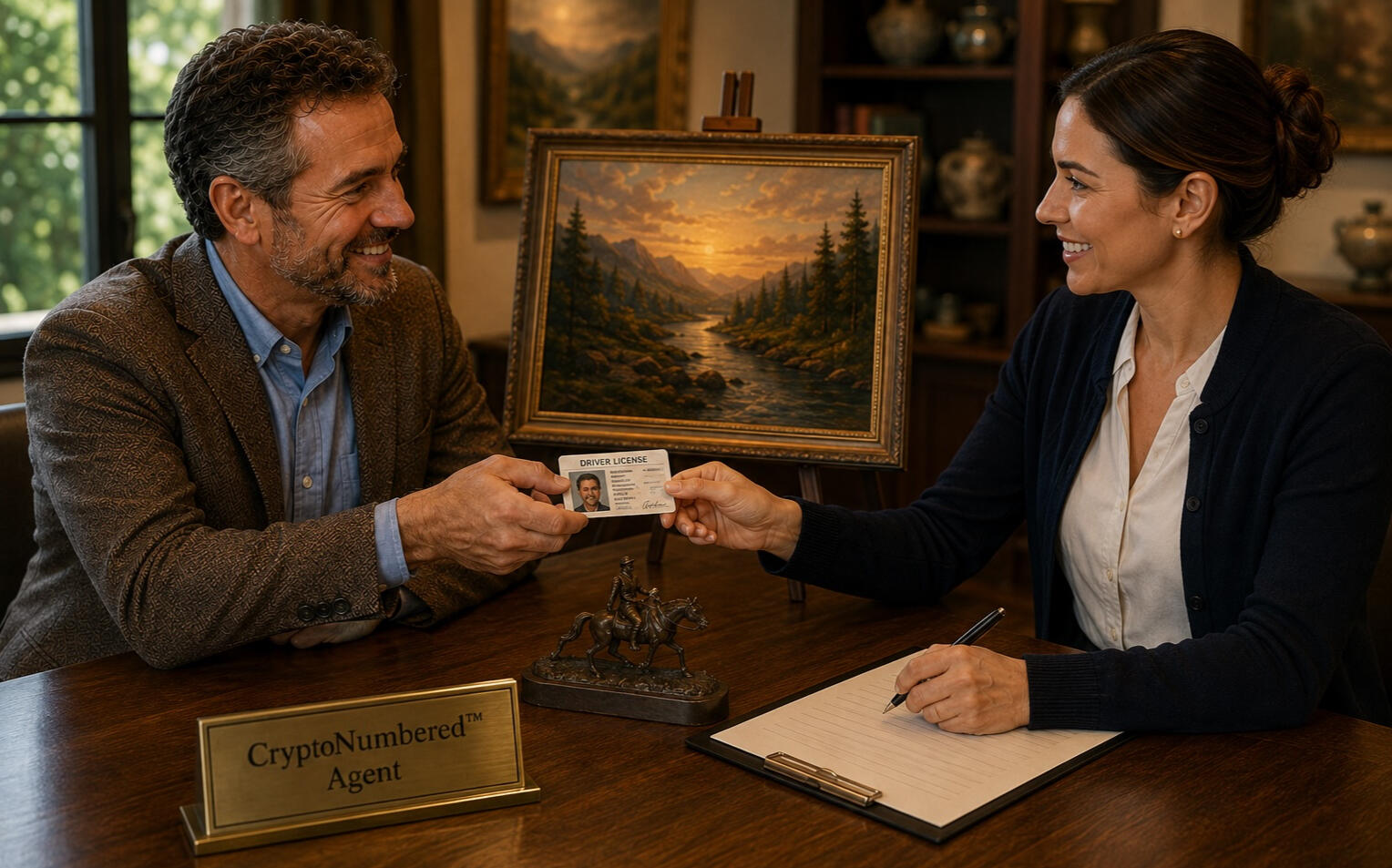
The registrant (you) meets with a CryptoNumbered Provenance Agent, presents the artifact, and provides government-issued identification.
Whenever practical, the Agent does not touch or take possession of the artifact. It remains in your control while the Agent observes it and witnesses the registration process.
The Agent is documenting a custody event. CryptoNumbered registration is not an appraisal, authentication, determination of ownership, or statement of value.
You Describe the Artifact
You provide the description of the artifact that becomes part of the record.
This distinction is intentional: the description belongs to the registrant. The Agent witnesses that the identified registrant presented the described artifact on the recorded registration date.
A standardized photograph is also made to visually associate the artifact with its record and unique CryptoNumbered Record Identifier (CRI). This is not intended to be a beauty or studio photograph, simply a clear, representative image of the artifact as presented.
A Physical Certificate Is Created
The Agent completes a serialized CryptoNumbered Certificate documenting the registration.
The certificate is produced on acid-free archival paper and completed using archival ink, making it suitable for long-term storage with the artifact’s records.
The Agent signs and stamps the certificate, providing a physical record of the witnessed registration event.
Each certificate is associated with a unique CryptoNumbered Record Identifier (CRI) printed on a tamper-evident hologram.
Importantly, the physical certificate has evidentiary value of its own. Even in the absence of access to the Registry, it provides physical documentation of a dated, witnessed custody event.
The Information Enters the Registry
Information from the certificate is entered into the CryptoNumbered Registry.
Core certificate data is stored in a PostgreSQL database hosted on AWS infrastructure, with daily backups and disaster-recovery protections. Artifact and certificate images are stored separately from the core certificate data.
AWS (Amazon Web Services) is one of the world’s largest cloud infrastructure providers and is widely used by financial institutions, governments, healthcare organizations, and major enterprises.
Each finalized Provenance Record is cryptographically hashed, creating a unique digital fingerprint of the record as it existed at that time. That fingerprint is then permanently anchored to the Bitcoin blockchain, providing independently verifiable evidence against later alteration of the recorded information.
The CRI Is the Key
The CryptoNumbered Registry is not a browsable database of artifacts or registrants. Each record is accessed individually using its unique CRI.
Anyone who has been given the CRI can use it to view basic Registry information associated with that individual record. This provides an easy way to share a record with someone who has a legitimate reason to see it, such as an insurer, bank, prospective buyer, auction house, or other interested party.
Having one CRI does not provide the ability to browse the Registry, search for other artifacts, or discover other registrants.
If the registrant has authorized photograph access, the artifact photograph may also be displayed as part of the CRI-accessed record. It is never placed in a publicly browsable image database.
Related Artifacts
CryptoNumbered records can be connected to other related records.
A related artifact might be a companion painting, an item from the same collection, or supporting documentation such as a magazine article featuring the artwork, an appraisal, a receipt, exhibition material, or other provenance evidence.
Each is treated as its own artifact with its own CRI, but related records can be linked together. From a CRI record, a viewer can click a related CRI to open that record directly, making it easy to move between an artifact and its associated items or supporting documentation.
This allows collectors to build an organized, interconnected record of an artifact’s supporting history.
Some Information Remains Limited-Access
Contact information and other limited-access information are not displayed through the general CRI lookup.
For security, CryptoNumbered does not store the physical location of the artifact.
Limited-access Registry information may be accessed only through a CryptoNumbered Provenance Agent, with the registrant present and the physical CryptoNumbered Certificate in hand.
This allows useful information to be preserved without turning the Registry into a searchable database of collectors, owners, their contact information, or their artifacts.
If the Artifact Changes Hands
A CryptoNumbered record preserves a custodial event.
If the artifact is later sold or otherwise transferred to a new custodian, a new CryptoNumbered record can be created. This is done in the presence of a CryptoNumbered agent. The new record includes a historical link to the prior record, allowing the artifact’s documented provenance to continue while preserving the earlier custody event.